 English
  Tiếng Việt
 1. Giới thiệu
Low Earth Orbit (LEO) is a satellite orbit region located between 160 km and 2,000 km above the Earth's surface. This is the most favored orbit for modern telecommunications applications, including Starlink's high-speed internet satellite network – a key project of SpaceX.
With the characteristic of being close to Earth, LEO enables data transmission with low latency, high speed, and effective global coverage. This article will delve into the structure, technology, and technical advantages of LEO in the Starlink satellite ecosystem.
2. Đặc trưng kỹ thuật của quỹ đạo LEO
2.1 Vị trí và đặc tính quỹ đạo
LEO is located between 160 and 2,000 km above the Earth's surface, much lower than the GEO (geostationary) orbit at 35,786 km.
Satellites in LEO move at a speed of approximately 7.8 km/s, completing one orbit around the Earth in 90–120 minutes.
2.2 Ưu thế về độ trễ và tốc độ truyền tải
Low latency: Due to the close physical distance, LEO satellite signals take only 20–40 ms to transmit, significantly reduced compared to the 500 ms latency of GEO satellites. This is suitable for applications requiring instant feedback such as video conferencing and online gaming.
High bandwidth speed: LEO satellites support download speeds from 100 Mbps to over 300 Mbps thanks to optical laser links and modern antenna technology.
2.3 Tần suất quỹ đạo nhanh
The short orbital cycle causes LEO satellites to move continuously, creating high demands on ground-based transceiver equipment and network coordination mechanisms to maintain continuous connectivity.
3. Công nghệ nền tảng của Starlink trên quỹ đạo LEO
3.1 Mạng lưới vệ tinh quy mô lớn
Starlink currently operates and plans to deploy about 12,000 – 42,000 satellites, forming a tightly linked satellite network in LEO.
3.2 Liên kết laser quang học giữa các vệ tinh
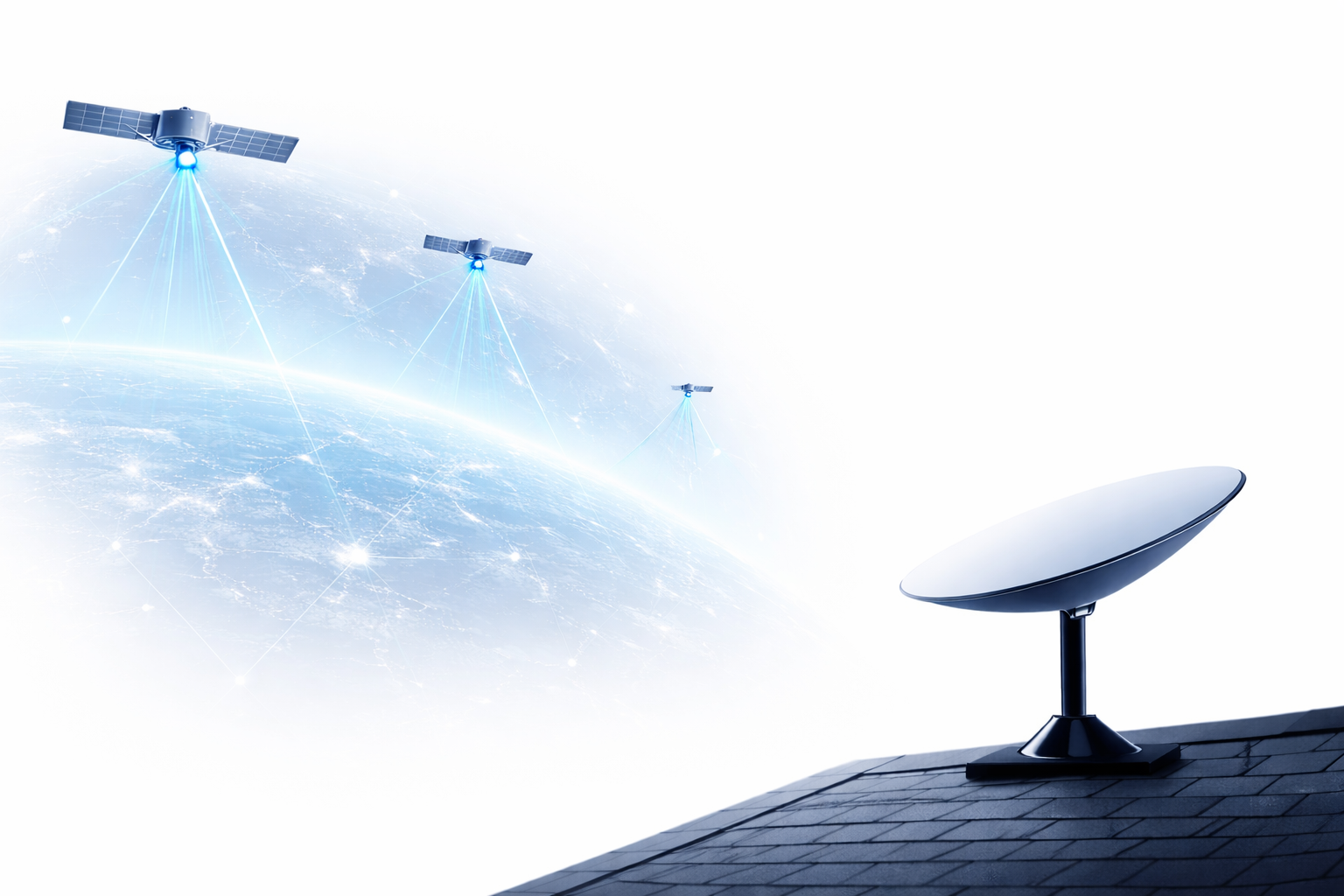
Unlike traditional satellite systems, Starlink is equipped with optical laser links between satellites, allowing data to be transmitted directly between satellites without always returning to ground stations. This optimizes bandwidth, reduces latency, and increases network reliability.
3.3 Thiết bị thu phát người dùng – anten mảng pha điện tử
The Starlink transceiver dish uses a phased array antenna, allowing for rapid and precise electronic wave control to track moving satellites in the sky without the need for physical movement mechanisms. This device connects directly with satellites in the LEO network, ensuring stable, high-speed signals.
3.4 AI và phần mềm quản lý mạng thông minh
SpaceX applies artificial intelligence (AI) and machine learning (ML) algorithms to coordinate the operation of the satellite network, optimize data transmission paths, predict and handle network issues, and automatically update software on satellites and user devices.
4. Ưu điểm vượt trội của quỹ đạo LEO trong mạng Starlink
Low latency: Provides a network experience equivalent to or better than traditional fiber optic networks for end users.
High transmission speed: Supports large bandwidth to meet diverse needs from individuals to businesses.
Global coverage: A dense satellite network provides continuous coverage in all areas, including remote regions.
Upgrade and maintenance capability: Short satellite lifespan allows SpaceX to replace and upgrade new generation satellites flexibly.
Terminal equipment flexibility: Compact user devices, easy to deploy with high automation capability.
5. Thách thức kỹ thuật và giải pháp quản lý
5.1 Rác thải không gian và va chạm vệ tinh
The large number of satellites creates pressure on space debris, posing collision risks. SpaceX has developed self-destruct or deorbit mechanisms for satellites at the end of their life to minimize debris, while applying orbital coordination algorithms to effectively avoid collisions.
5.2 Phổ tần và sự can thiệp sóng
Satellite frequency management is a major legal and technical issue, requiring international coordination to avoid interference with other services while optimizing spectrum usage efficiency.
5.3 An ninh mạng và bảo mật dữ liệu
Global satellite networks require high-level security standards to prevent attacks, ensuring information safety and user privacy.
6. Ứng dụng thực tế và tiềm năng phát triển
Broadband internet for remote and island areas not yet covered by traditional internet.
Global positioning systems (GPS, Galileo, GLONASS) and Earth observation for resource and climate management.
Mobile communication, military, and emergency rescue.
Next-generation network infrastructure (5G/6G), IoT based on satellite connectivity.

7. Triển vọng tương lai
Developing new-generation satellites with integrated smart antennas, stronger signal processing, and lower energy consumption.
Enhancing AI applications for satellite network management, improving automation, stability, and bandwidth optimization.
Multinational cooperation to build a sustainable, safe, and efficient satellite ecosystem.
Integrating LEO satellite networks with modern communication technologies like 5G, expanding connectivity capabilities.
8. Kết luận
LEO orbit is the strategic foundation that enables the Starlink satellite network to become a modern global internet solution, meeting high demands for latency, speed, and stability. LEO satellite technology, optical laser links, phased array antennas, and intelligent management software form the most modern connectivity ecosystem today.
Despite technical and legal challenges, LEO orbit opens a new era for satellite internet networks, contributing to bridging the global digital divide, and promoting digital economic and smart social development.